When Does Stress Testing Become Strategic?
When Does Stress Testing Become Strategic?
Insurance has always been built around uncertainty. What changes over time are the sources of that uncertainty, the way they interact and the speed at which they can affect the business.
Inflation may behave differently from past experience, interest rates move unexpectedly, severe weather and longer-term climate trends alter exposure patterns, reinsurance pricing and capacity change, and economic or geopolitical developments reshape business conditions. Increasingly, insurers must also manage several pressures at the same time rather than respond to one isolated event.
In practice, stress testing can remain closely associated with regulatory compliance. The exercise may be completed, documented and presented, but still have limited influence on capital planning, reinsurance, investments or underwriting decisions.
The real test of the framework is not whether scenarios were produced. It is whether the organization is better prepared to make decisions when conditions change.
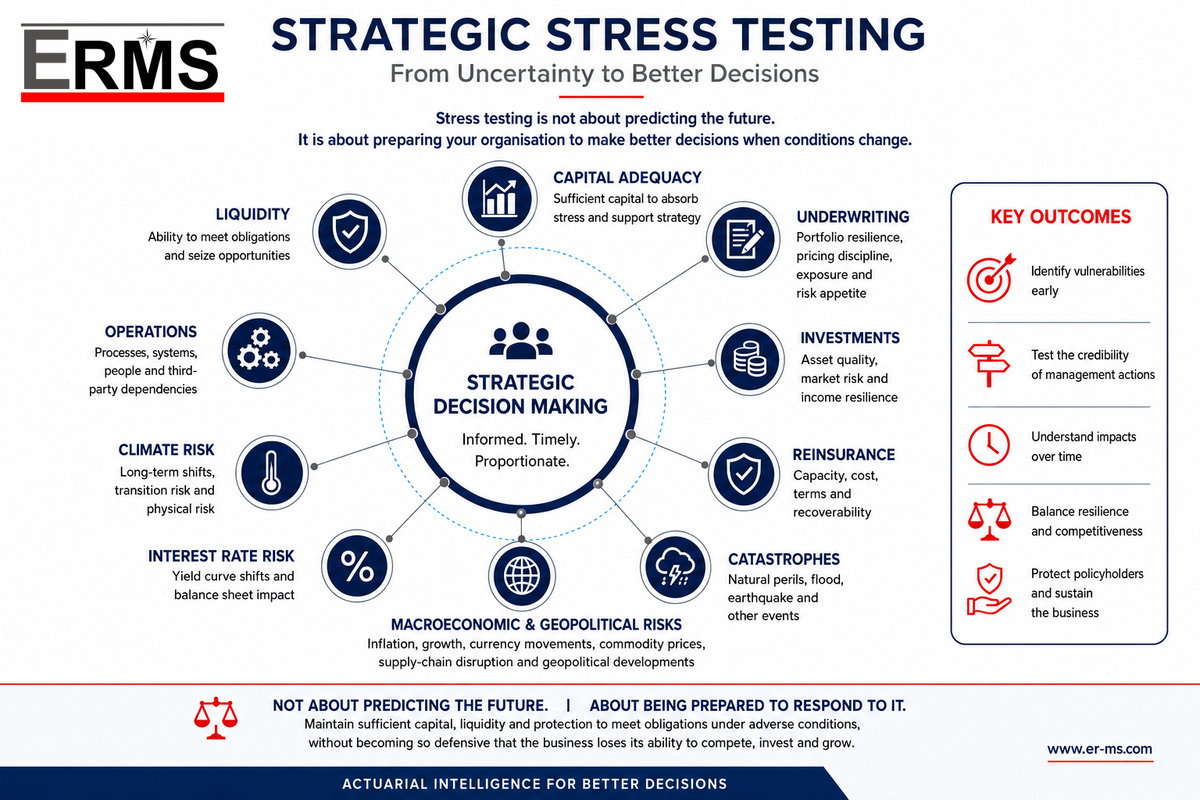
Preparation does not mean protecting the company against every conceivable event or maximizing every protective buffer independently.
Holding significantly more capital than the company’s needs and risk profile justify, purchasing reinsurance without sufficient regard to its cost and effectiveness, or adopting excessively conservative investment and underwriting strategies may appear to increase resilience. But these choices also carry a cost. They can reduce returns, restrict growth and weaken the company’s ability to compete and invest.
The opposite approach is equally problematic. Assuming that current loss experience, market conditions, reinsurance capacity or asset performance will continue can leave the insurer exposed when the environment changes.
The objective is therefore to maintain sufficient capital, liquidity and protection to meet obligations and protect policyholders, while deploying those resources efficiently. It is an informed balance between resilience and the insurer’s ability to operate, compete and grow sustainably.
That balance cannot be assessed through isolated percentage shocks alone.
A flood scenario, for example, should not stop at an increase in claims. It may affect operational capacity, claims handling, liquidity, the timing and collectability of reinsurance recoveries, future pricing, underwriting appetite and the availability or cost of reinsurance protection at the next renewal.
A longer-term climate scenario may raise different questions. It may affect where the company is willing to write business, how exposures are accumulated, whether historical experience remains relevant and whether some portfolios continue to generate an adequate return for the capital they consume.
The same applies to economic and geopolitical developments. Their effects may emerge through inflation, currency movements, investment values, supply-chain disruption, customer behavior or changes in the cost and availability of reinsurance.
A useful scenario therefore tells a coherent business story. It begins with a credible event or development, follows the channels through which it could affect the insurer and recognizes that underwriting, investments, liquidity, operations and reinsurance do not move independently. It does not simply move a series of unrelated assumptions and report the resulting solvency ratio.
Nor does strategic value come from making every assumption as adverse as possible. A scenario should be severe enough to expose vulnerabilities, but sufficiently coherent to reveal meaningful decision points, limitations and potential responses.
Time is another important dimension.
A company may remain solvent immediately after a shock but deteriorate over the following quarters because of delayed recoveries, continuing claims inflation, reduced premium volumes or a more expensive reinsurance program. Another company may experience a sharp initial deterioration but recover more quickly through earnings, repricing or changes in business mix.
A single point-in-time solvency result cannot adequately capture these different paths. Management needs to understand not only the initial impact, but also how capital, liquidity and earnings may develop over time and how long the company could remain outside its risk appetite or in breach of relevant risk limits.
Management actions must also be credible.
Raising capital, reducing dividends, changing investment allocations, adjusting underwriting appetite or restructuring reinsurance may all be valid responses. But they should not be inserted into the model automatically. Their timing, feasibility, cost, governance requirements and operational consequences need to be considered.
Management actions that appear feasible for one insurer in isolation may become much less effective when many insurers and market participants are under stress at the same time. Reinsurance capacity may be constrained, assets may need to be sold into stressed markets, or capital may be difficult to raise precisely when it is most needed.
This is where board and management ownership become important. The board does not need to design the stress-testing model, but it should understand the scenarios, challenge the principal assumptions and consider the implications for the company’s strategy and risk appetite.
Stress testing should create a practical discussion about what the company would actually do, how quickly it could act, which indicators would trigger intervention and which decisions should be taken before a difficult situation arises.
A mature framework does not need to be unnecessarily complex. It needs to reflect the insurer’s material risks and be connected to the way the company is managed. It should support business planning, capital decisions, reinsurance strategy, investment allocation, liquidity management and risk appetite without becoming a separate process that consumes significant resources but changes little.
No individual stress scenario will predict the future. That is not its purpose.
Its purpose is to expose vulnerabilities, test whether proposed responses would remain credible under pressure and help management make better decisions before action becomes urgent. The insurer should have sufficient capital, liquidity and protection to meet its obligations under adverse conditions, without becoming so defensive that it loses the ability to compete, invest and grow.
That is what turns stress testing from a regulatory output into a management tool.
Disclaimer: This article is provided for general information and discussion purposes only. It does not constitute actuarial, accounting, legal, regulatory, investment or other professional advice and should not be relied upon as such. The observations are general in nature and may not apply to a particular company, jurisdiction or circumstance. Appropriate professional advice should be obtained before acting on any matter discussed.
Discuss this topic with our advisory team
Contact ERMS to explore how these regulatory or market shifts impact your specific risk and capital frameworks.
Contact ERMS