IBNR: The Science of Predicting the Past
IBNR: The Science of Predicting the Past
At first glance, the title sounds like a contradiction.
Prediction is usually associated with the future. We forecast next year's sales, tomorrow's weather or future claim frequencies. Claims reserving is different.
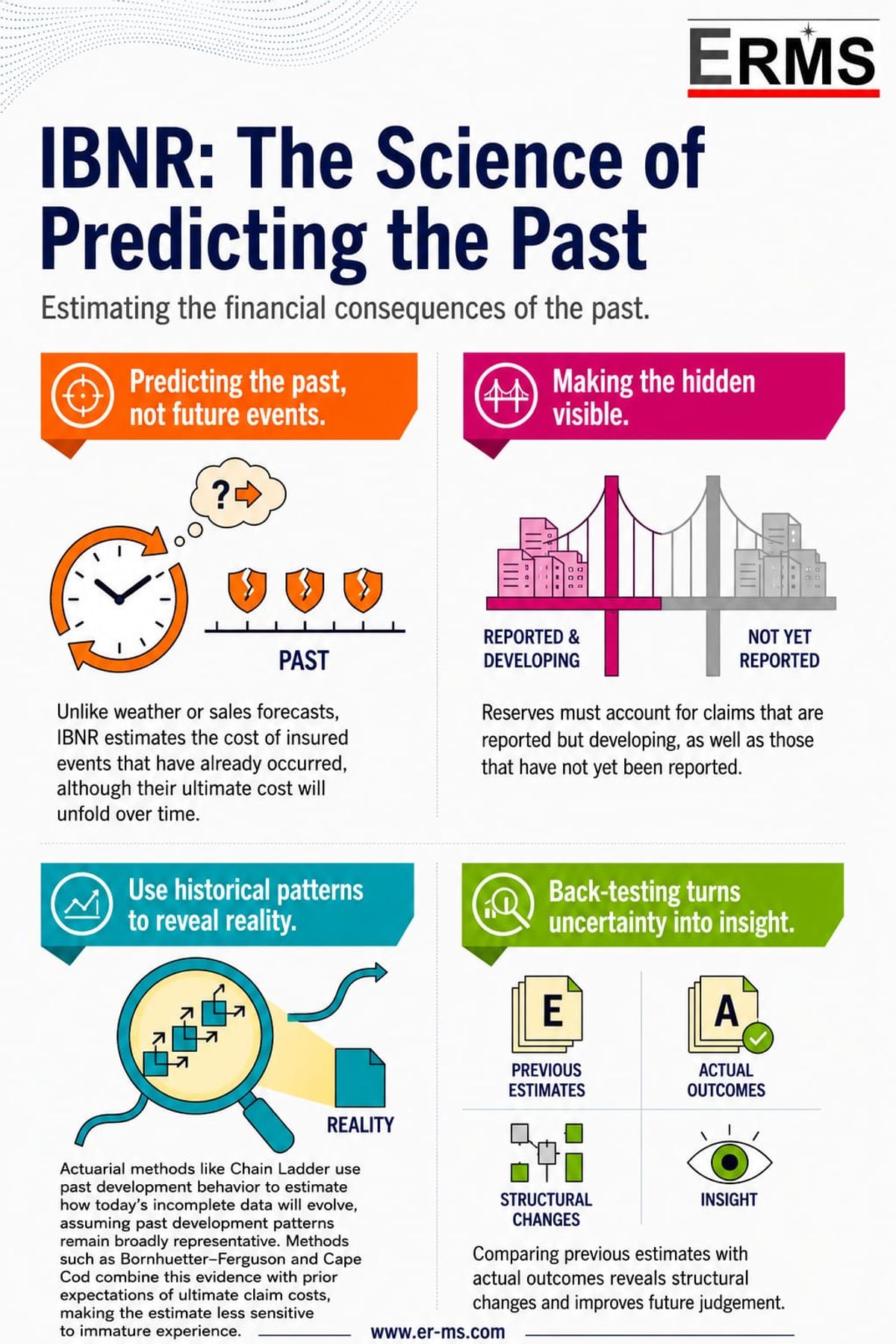
When actuaries estimate IBNR, they are not predicting future insured events. The insured events giving rise to the liabilities have already occurred. The uncertainty lies in what has already emerged, what remains hidden, and how the ultimate financial consequences of those past events will develop over time.
In that sense, claims reserving is less about predicting future events than estimating a past that has not yet fully revealed itself.
This distinction is subtle, yet fundamental. An underlying reality already exists, but only part of it is visible at the valuation date. Some claims have been reported while others remain unknown. Reported claims may develop materially as new information emerges, and claims that have not yet been reported may still surface. The ultimate cost of those past events gradually becomes clearer as reporting, settlement and development continue over time.
This gradual revelation is why claims reserving relies so heavily on historical development patterns. Methods such as Chain Ladder, Bornhuetter-Ferguson and Cape Cod are built on the principle that the way claims developed in the past provides useful evidence about how today's incomplete picture is likely to evolve. In methods such as Bornhuetter-Ferguson and Cape Cod, this evidence is combined with prior expectations of ultimate claim costs, making the estimate less sensitive to immature experience.
Like any model, however, this relies on the assumption that historical development patterns remain broadly representative. When claims handling practices, underwriting strategies, legislation or the external environment change materially, that assumption deserves careful challenge.
Of course, no reserving method eliminates uncertainty. Data quality, inflation, legal developments, operational changes and professional judgement all influence the estimate. Whether using deterministic or stochastic methods, the objective remains the same: to estimate the ultimate financial consequences of events that have already occurred using the information available at the valuation date. Models organise the available evidence and help quantify uncertainty, but they do not replace actuarial judgement.
Perhaps the most fascinating aspect of claims reserving is that, unlike many forecasting disciplines, estimates are progressively assessed as claims continue to develop. Each valuation becomes an opportunity to compare previous estimates with subsequent experience, providing valuable insight into the strengths and weaknesses of assumptions, methods and judgement.
This is why back-testing is far more than a model validation exercise. It is a learning process. Consistent patterns of overestimation or underestimation may reveal structural changes, weaknesses in assumptions or emerging risks that deserve closer attention. Looking backwards ultimately improves our ability to estimate what remains hidden today.
IBNR is often viewed as a technical calculation. In reality, it is an exercise in interpreting incomplete evidence and forming a reasoned view of an underlying reality that has not yet been fully observed.
Perhaps that is what makes claims reserving one of the most intellectually distinctive areas of actuarial science.
It is, in many ways, the science of predicting the past.
Disclaimer: The information presented in this article is intended for general professional discussion and does not constitute actuarial, accounting, legal or other professional advice. Specific circumstances should always be assessed before relying on the concepts discussed.
Discuss this topic with our advisory team
Contact ERMS to explore how these regulatory or market shifts impact your specific risk and capital frameworks.
Contact ERMS